
Rich Youmans
Books in Brief

The Heart of the Haibun
By Roberta Beary
Buttonhook Press
An imprint of OPEN: Journal of Arts & Letters (O:JA&L)
2026, digital (PDF), 50 pages
Available for Free Download
Roberta Beary’s last full-length collection, Crazy Bitches (MacQ Books, 2025), compiled 80 of the author’s finest haibun and was honored in both the Touchstone Awards and the HSA Merit Book Awards. It’s a testament to Beary’s prolific talent that this new chapbook offers an additional 10 haibun that did not appear in Crazy Bitches but are of equally high caliber. The pieces are billed as “representative work” and they fit that title. Beary has never hesitated to write about life’s traumas, and the topics here include bad husbands, bad (and likely abusive) fathers, heartbreaks, child abuse, and those who generally have suffered in some way. As she notes to O:JA&L associate editor Pamelyn Casto in the Q&A that ends the book, she writes to connect with others and especially for those “who feel their pain is too big to voice.” In several pieces she accomplishes this by writing “fractured” versions of familiar fairy tales and nursery rhymes. In all pieces, she displays a mastery at pacing and saying just enough to lead a reader on.
As part of Buttonhook’s Masters Series, the chapbook follows the series’ format by offering not just representative work and the Q&A, but also a craft essay. That essay, “The Heart of Haibun: A Journey in Four Parts,” was adapted from a 2024 talk she gave at the Third International Haiku Conference in Poland, and it provides invaluable lessons. Beary offers some familiar but still important advice about writing and submitting haibun (e.g., submit your best work, trust your reader), explicates three of her own haibun, and offers two writing exercises. Best of all (at least for me), the essay presents Beary’s own rewriting process, providing an example in which she explains the choices she makes through successive drafts. The art of rewriting is undersung, in my opinion, and Beary offers an excellent illustration of how it can help a piece to improve (even if it’s already been published—as she says, it’s never too late to revise).
The closing Q&A offers her personal views on the state of haibun, the hits and misses she’s encountered as the longtime haibun editor of Modern Haiku, and what continues to inspire and drive her to write. In many respects, The Heart of the Haibun works as an ancillary to Crazy Bitches, expanding that collection and providing exemplary insights from one of the form’s best writers.
Excerpts:
Mary Mary Quite Contrary
Ever since her husband left, Mary-Mary spends her days inside her small tumbledown cottage. Her neighbor down the lane says she once tended a lovely garden. Bordered by rows of silver bells and cockle shells. When she wasn’t singing to the roses, she could be seen on a pretty stone bench. Knitting tiny clothes. Now the garden is nothing but pebbles and dry grass. Even stray sheep know not to nuzzle the broken gate. Her neighbor down the lane says Mary-Mary is entitled to daily meditation classes at the community centre, weekly sessions with a psychologist, and a monthly stipend. But whenever the social welfare officer buzzes Mary-Mary’s intercom, the security camera blinks red and the door stays shut. Her neighbor down the lane says Mary-Mary keeps herself to herself. No one knows why.
blackbird unstitching the baby blanket blue
The End of Everything at Killary Fjord
We didn’t know. We say, let’s take a drive. The coastal roads of Mayo give way to Galway. No others on the road. We don’t wonder why. Instead, we drive on, past each scenic overpass. Until the fjord shines before us.
A trick of light, how water meets sky. We might have cloud-walked to the other side. Our eyes follow hillside sheep. Bleating a language we once knew. The next day the order came. The entire country under house arrest.
Today Killary Fjord lives only on our photo app. You in tartan scarf and matching cap. Me in pink cape and hat. Our arms forever linked. As puffy clouds billow over blue water.
neither here nor there day moon
A Lantern on the Bridge
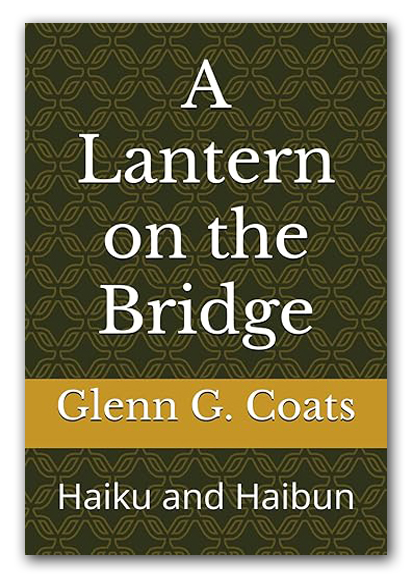
By Glenn G. Coats
Pineola Publishing
Carolina Shores, North Carolina
2025, paperback, 100 pages
ISBN: 979-8-268668-43-8
$15.00 USD
Ordering Information
Glenn Coats’s latest book is one of recollection, filled with moments and narratives of his mother and father, family and friends, joys and losses. As he recounts in an afterword, Coats returned to his native New Jersey in 2023 to be closer to his ailing mother, and while there he found inspiration for his writing: “My haiku were filled with images of the past and present,” he says,” while my haibun spiraled down pages in the form of free verse.” The first portion of the book contains 30 haiku divided into three sections. The first two sections offer moments before and after his mother’s death, and the third is devoted to the river (the Raritan) where he fished as a child and, as he writes, “is so much a part of who I am.” In the 26 haibun that follow, he recounts episodes from childhood, reflects on time’s passing and the surprises it brings, and remembers his family— his grandparents, his mother and father, his sister, his wife.
Coats is a writer of restraint who knows how to present a scene with a few apt details. In the book’s haibun, his use of thin, lineated lines—each containing no more than a few words, often only one—emphasizes these traits, forcing the reader to slow down and absorb what’s being said more carefully. Throughout, Coats writes with a clear eye as he remembers both good times (his parents’ courtship and marriage, his own budding relationship with his wife) and hard (his sister’s quiet after emerging from rehab, his father’s ailing health). These are not sentimental haibun. Instead, the overall feeling is one of poignancy—sometimes tinged with humor, at other times with wonder, and always with an appreciation for what he’s experienced. (The book won an honorable mention in the HSA 2026 Merit Book Awards for haibun.)
Excerpts:
Creatures
I find
Mola mola
in my grandfather’s
Book of Knowledge;
it is called
an ocean sunfish
round
like a two ton
flying saucer;
Grandfather says
they drift
through the inletby mistake
and swim through
Barnegat Bay
and into the mouth
of our river;
one of the things
they like is squid
and we keep that
in the freezer.I pick the longest
surf rod
hanging in the
garage,
carry it down
to the peninsula
that
juts into the water,
tie on
the largest hook
and heaviest weight;
bait it
with a long strip
of squid,
wade to my hipsthen cast towards
the channel
as stars begin
to appear
and mosquitoes
start to bite.shoreline breeze
invisible beaks clatter
through the marsh grass
White Light
After the heart attacks—
he can’t recall
the names
of the nurses;
doesn’t remember
pulling at tubes
and sensors
or swatting the IV stand
like a punch-drunk
boxer;
he’s not sure
if his sister played
his favorite songs
or whether
he sang along.After the heart attacks—
he thinks
there was a mist—
a cloud or a lake
around the bed;
he might have been
floating;
there was a chair
close to him
where his wife
with golden hair
might have been
sleeping;
maybe—she was there
the whole time.lost at sea
the dissonant bells
on a hospital ward
Thank you Rich, for this thoughtful review, much appreciated.