
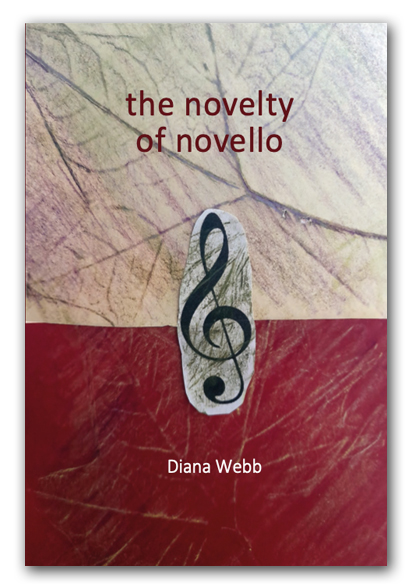
Book Review: the novelty of novello
By Diana Webb
Alba Publishing
2026, paperback, 68 pages
ISBN: 978-1-912773-79-4
£12.99 GBP
Ordering Information

In her preface to this book, Diana Webb shares her goal of imagining “what feelings [the same piece of music] may be eliciting simultaneously in other listeners who I’ll never meet.” More specifically, a note on the back cover says this collection “concerns two very different female characters conversant with her [the author’s] favorite genre, who hear a song and respond with pieces in the form relevant to their respective situations.” Reading through those pieces, I found it heard to discern the individual stories of these two characters (an older woman recovering from a hip operation and a struggling art school graduate). I also found this complex context unnecessary: most of the 51 haibun in this book have a life of their own, and they effectively celebrate the ways music communalizes emotion.
The title poem, which references the early 20th century Welsh composer Ivor Novello, reminds us to listen:
Dusk. A song plays out from a radio station all over London. It travels the airwaves through myriad dwellings, in most barely noticed. To many hearers it registers briefly as they make preparation for a special night out or a visit from someone half recollected from who knows where… A grandmother’s eyes. A rhythm of words. A disc revolving. A weave of melancholy tinged with bliss.
voyage
the land so near
so far
Webb then strings together the opening lyrics of Novello’s 1945 song “We’ll Gather Lilacs” between a set of the opening haibun. Those lyrics (“We’ll gather lilacs in the spring again / And walk together down an English lane / Until our hearts have learned to sing again) create a nostalgic world of the English countryside after World War II:
Bypass of the latch
The one that skirts the river then turns sharp right uphill past the entrance to the jewel box of the tiny bluebell wood where lapis lazuli can be extracted and set into your poems of sky and sea. The scent of it.
 five bar gate
 the song to footfalls
over the threshold
Here, even the gate takes on a musical quality with its “five bar[s].”
In another haibun, “Serenade,” the world, itself, seems to be created out of music:
It means to sing you through a window to woo you through the
beauty you share in a to and fro of you in and out of the vocal
dance for in the beginning was…a voice that spoke out three
words… let there be…lantern slide
bones of a wing waltz light
through dark branches
Sometimes, in reading, I would have appreciated a dialing back of some of the romanticism and nostalgia attached to an idealized childhood, as well as a repeated vocabulary related to magic and faeries. I was most engaged and moved in those of Webb’s haibun where the quotidian lives of characters are juxtaposed with sudden snippets of music from another register, as in this haibun:
Receives rain still
Pockmarked and cracked over time by the elements, the birdbath overflows with tap water each time she comes to refill it from her Tupperware jug. As she approaches, the ground around it throws up dust. Weeks of drought. This morning a dense cloud overhead. She feels the weight of her years yet something inside her stirs, rings out through a fissure. From deep in the dried-out stone of the bowl’s shallow hollow there comes an echo.
darkest hour
through a short sharp shower
the magic flute
I also appreciated where Webb shifts from sound into the rarer sensory world of smell and touch, as she does in the opening of “Masking the Aroma of Roasting Turkey”:
On a damp dark December evening as we open the door to the chemist’s shop, a warming mingle of secret floral scents greets the nostrils from the piled-high toiletry altar. I breathe in the certainty of what my mother would like.
Yardley’s freesia talc
from my palm a metal sweat
those clutched half crowns
The collection’s second half opens with another set of lyrics from “We’ll Gather Lilacs,” which Webb intersperses among haibun introducing the struggling art school graduate. Many of the haibun live in a deeply-felt and imagined nostalgia of London drizzle, sometimes with the moodiness of The Beatle’s “Eleanor Rigby”:
Autumn reverie
The widower returns from late Sunday roast in his favorite pub, reflects on memories. Next door the weekend visitor waves goodbye at the gate before getting into her car to depart for home. Jazz plays out a version on the radio while on the horizon a gap between canopies, wine glass shaped, fills up with a shade of sunset glow.
cocktail at nightfall
pink gin embellished
with tree silhouette
The collection’s range moves more broadly in this second half. It includes references to a range of literary and visual artists—Mark Rothko, Gerard Manley Hopkins, and the British composers Ralph Vaughan Williams and Eric Ravilious, among others. It also includes some of Webb’s formal experimentations, such as a cento-like ekphrastic that’s based on Jean-Baptiste-Camille Corot’s Souvenir Mortefontaine and includes sampled poetic phrasings from Robert Browning, Basho, John Keats, A.E. Houseman, William Wordsworth, and Thomas Traherne. She also offers this parodic variation on Pete Seeger’s “Where Have All the Flowers Gone”:
Enwrapped in the threads
Where have all the dewdrops gone?
Gone into cobwebs every one.
Where have all the cobwebs gone?
Into a child’s imagination every one
Where has that imagination gone?
Gone into distant stars every one.
Where have all the distant stars gone?
Gone into blossoms every one.
Where have all the blossoms gone?
Gone into tears that fall like dewdrops every one.buttonhole star
in Great Great Grandad’s portrait
lost constellations
The critic Walter Pater once said, “All art aspires to the condition of music.” Throughout this book and its lyrical works, Webb shows the truth in that adage. While ostensibly about two women (both of whom pass each other in the book’s final haibun, humming a tune that we can assume is Novello’s), the novelty of novello is can really more than that. In essence, it provides a catalog of the author’s far-ranging interests and experiences, and is also a testament to her talent for finding the music in her own chosen art form, the haibun.
About the Reviewer

Judson Evans is a full-time Professor of Liberal Arts at Berklee College of Music, where he teaches poetry workshops on haiku, haibun, and renku, and a visual studies course on Paleolithic cave art. His collaborative book of lyric poems responding to cave painting, Chalk Song, was published by Lilly Press, Boston, in fall 2021. He is haibun co-editor for Frogpond.