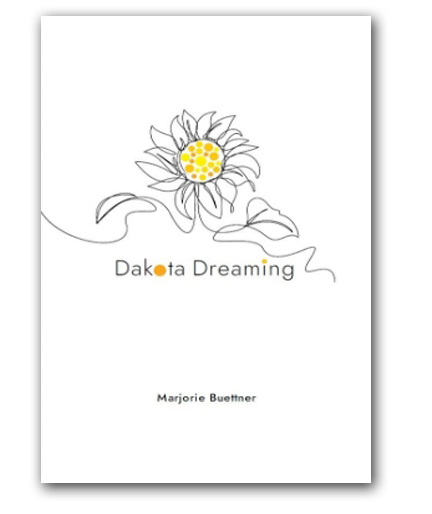
By Marjorie Buettner North Dakota State University Press Fargo, North Dakota 2024, paperback, 36 pages ISBN: 978-1-946163-69-1 $30 USD Ordering Information
The winner of the 2024 Poetry Plains & Prairies Award sponsored by North Dakota State University Press, this chapbook offers 33 poems—mostly haibun, along with tanka prose, individual haiku and tanka, and free-verse poems—that take the reader into the spirit of the Great Plains. Buettner, a North Dakota native who now lives in Chisago City, Minnesota, writes with reverence about the region, bringing to life its natural features and creatures, and honoring her family as an extension of the land. Throughout the book she references her dreams, whether they are of loved ones appearing and exiting like ghosts, of the landscape where winds sing and tornados wreak havoc, or of a realm where “you can breathe deeply and shed the dust off your days.” Reading through this collection, I had the sense that, as in a dream, the past, present, and future intermingle easily in this wide-open landscape. The book itself was prepared on letterpress by students in the university’s publishing program.
It must be the dance of the long prairie grass that I miss the most—how it bends and sways to the changing wind, rippling and quivering at each gust. Someone once said the prairie is a sea of grass as movable and mutable as the ocean, changing color in the shift of sun and clouds. Today I can almost hear it singing in the wind as each blade brushes against the other.
gust of wind
the underside of wildflowers
offered up
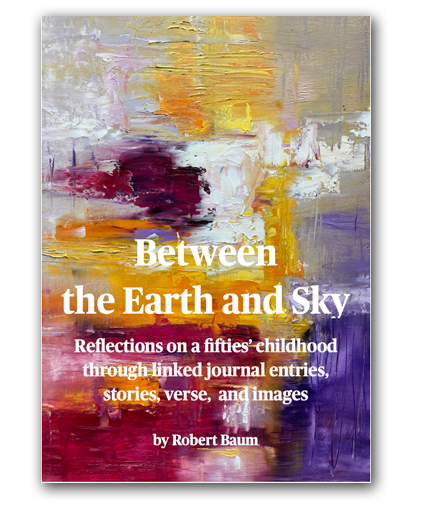
Between the Earth and Sky
By Robert Baum Self-published Kindle Edition 2024, 190 pages $7.99 USD Ordering Information
Robert Baum has drawn on his 1950s childhood for a coming-of-age novel, narrated by a fifth-grader named Henry Muller, that intersperses (albeit infrequently) some of the the author’s haiku, haiga, haibun, and general artwork. Many of the era’s cultural touchpoints (e.g., coonskin caps, bomb shelters, Elvis) appear throughout the chapters, as does the casual racism, homophobia, and other prejudices of the day (“lessons from childhood that had to be unlearned,” as Baum puts it). As for the haikai-related elements, only a handful of them appear throughout the book’s nearly 200 pages, and most serve as accents; only in a few instances do they really integrate with and expand the narrative. In one of those instances, a haibun that originally appeared in cho (“Transition“) has been modified to serve as the back story of a minor character. I wish there had been more such connections throughout the novel, and hope the author (and others) will continue to explore these hybrids and enlarge the contributions of the haiku, haibun, and haiga.
About the time Mama is studying rock-n-roll, Arthur Rhoads wanders into our lives. Arthur is the son of one of our neighbors down the highway, and he is out of work. Arthur stops at Dad’s shop and asks him for a job. His timing is spot on—Father’s orders are still falling behind. His partner is down, and now one of his metal spinners, Lee, is out for a while. Lee is recovering from lumps and bruises, a missing tooth, and a broken arm incurred when three rowdies followed him home Saturday night.
at the church social hall, Lee pulls his 10-year-old Ford pickup off the road, parks at the back of the lot. still in the driver’s seat he slips off his jeans and khaki shirt,
throws a green print dress over his head and pulls it down, kicks off his sneaks, and dons a pair of low-heeled pumps. she retrieves a bob-cut black wig from the glove box, long out of style, positions it just so. makeup overly done in an adolescent way.
alone inside at the piano Lea plays a progression of unrelated notes and chords not belonging to any particular time signature— this one evening a week Lea feels at peace— it will do for now.